KEEP IN MIND
- Read the marker legend.
- Separate dot membership from dot order.
- Compare a deliberate change between attempts.
- Check the submitted pattern before using its feedback.
Learn the marker meanings first
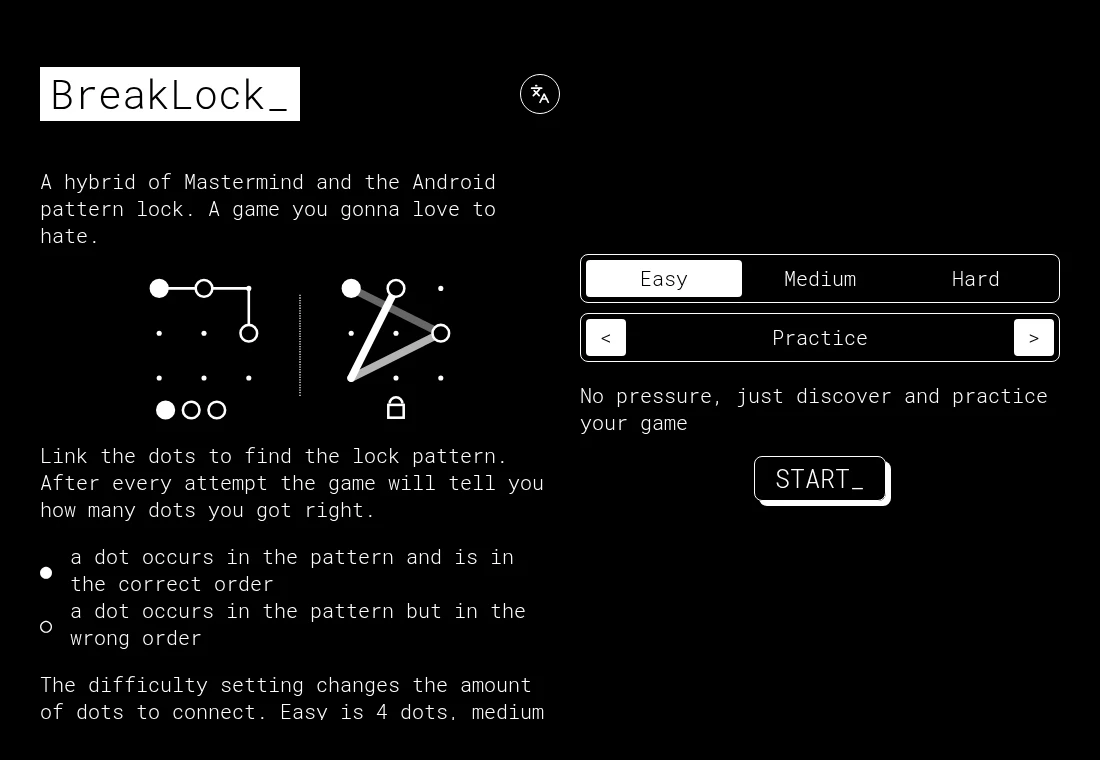
BreakLock combines a dot-pattern interface with Mastermind-style deduction. Its instructions distinguish correct dots in the correct position from correct dots placed in the wrong position. Read the marker legend in the linked build before comparing attempts. A familiar lock-screen gesture does not tell you how the puzzle scores a guess.
Keep membership and order separate
A marker for the wrong position still tells you that a chosen dot belongs somewhere in the hidden pattern. The next question is where it can go. Treat the selected set of dots and their order as two different parts of the candidate, otherwise changing both at once can make feedback harder to interpret.
Work through a small example
For an explanation, label distinct dots A, B, C, D and E. If a four-dot target is A–B–C–D, a guess A–B–C–E contains three correctly placed dots and one dot that does not belong. Swapping the first two to B–A–C–E leaves C correctly placed and A and B present in the wrong positions. The real feedback gives counts, so it does not identify those letters for you; you infer them by comparing attempts. This is a worked example, not a captured solution.
Make a controlled comparison
As a learning approach, alter a small part of a candidate and compare the next result with the previous one. You are trying to identify which change explains the feedback. This is reasoning advice, not a guaranteed minimum-guess algorithm; the legal patterns and current difficulty still come from the game’s rules.
Use practice before a timed mode
The project offers a practice route as well as other challenge modes. Use it to learn the draw-and-release gesture and the marker legend without trying to optimize speed immediately. Once the input is comfortable, choose a challenge that fits the session you actually want.
Pause when the gesture and the guess disagree
If the displayed pattern is different from the one you intended, resolve the input problem before reasoning from the score. Touch handling, dot spacing and an early release can affect what was submitted. A result from an unintended guess can still be valid feedback, but it belongs to that displayed pattern.