KEEP IN MIND
- Learn the first producer before the next tier.
- Trace a tier’s output toward the final currency.
- Read a purchase’s displayed effect.
- Keep a separate export before resets or imports.
Identify the first producer
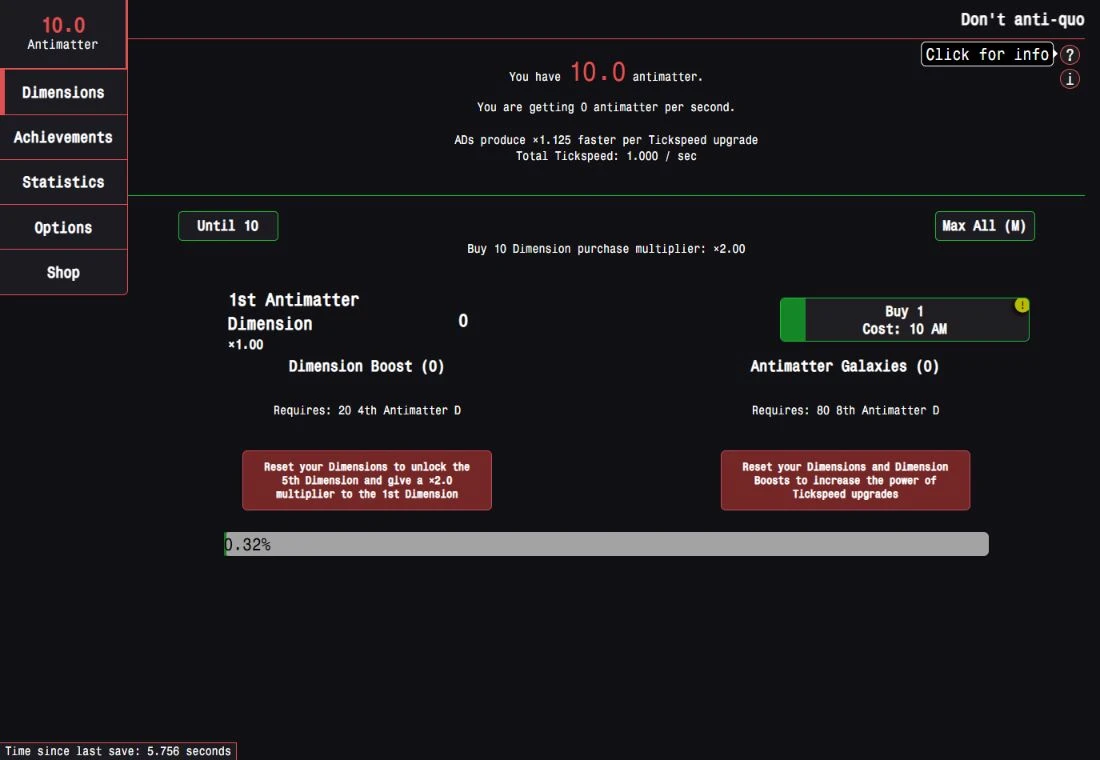
Read the first available dimension and its cost. Make a small purchase and observe which quantity starts changing. This is the smallest useful model of the economy. When another tier appears, compare its stated output with that first relationship instead of assuming every purchase directly adds the final currency.
Follow a higher tier downward
The game’s tiered production asks you to track more than a single counter. Look at the rate or amount of the lower dimension after buying a higher one. Seeing that connection helps explain why a purchase can matter before a large change in the antimatter display becomes obvious. This is a reading method rather than a fastest-growth formula.
Compare cost and displayed effect
Before repeatedly buying an enabled row, inspect its amount owned, price and multiplier or production effect. A different available action may address the current limitation. Change one purchase at a time while learning, so you can explain the new rate rather than guessing which of several clicks produced it.
Read the exact reset description
The game introduces progression layers over time. A reset is defined by its own retained and discarded progress, not by the word reset alone. Read the current control and keep an export before experimenting. This guide avoids importing a later-game prestige plan into the first few minutes of play.
Keep a backup separate from an experiment
The reviewed source implements browser slots and backups. Those are useful alongside an export, particularly before switching a host, fork or version. Preserve the earlier export separately before importing another save. An available import function does not establish compatibility, and a successful load should be checked before the old copy is discarded.