KEEP IN MIND
- Choose a specific movement lesson.
- Use puzzles for tactics after learning legal moves.
- Inspect a clock before joining a live game.
- Do not assume anonymous lesson progress syncs across devices.
Start from one movement rule
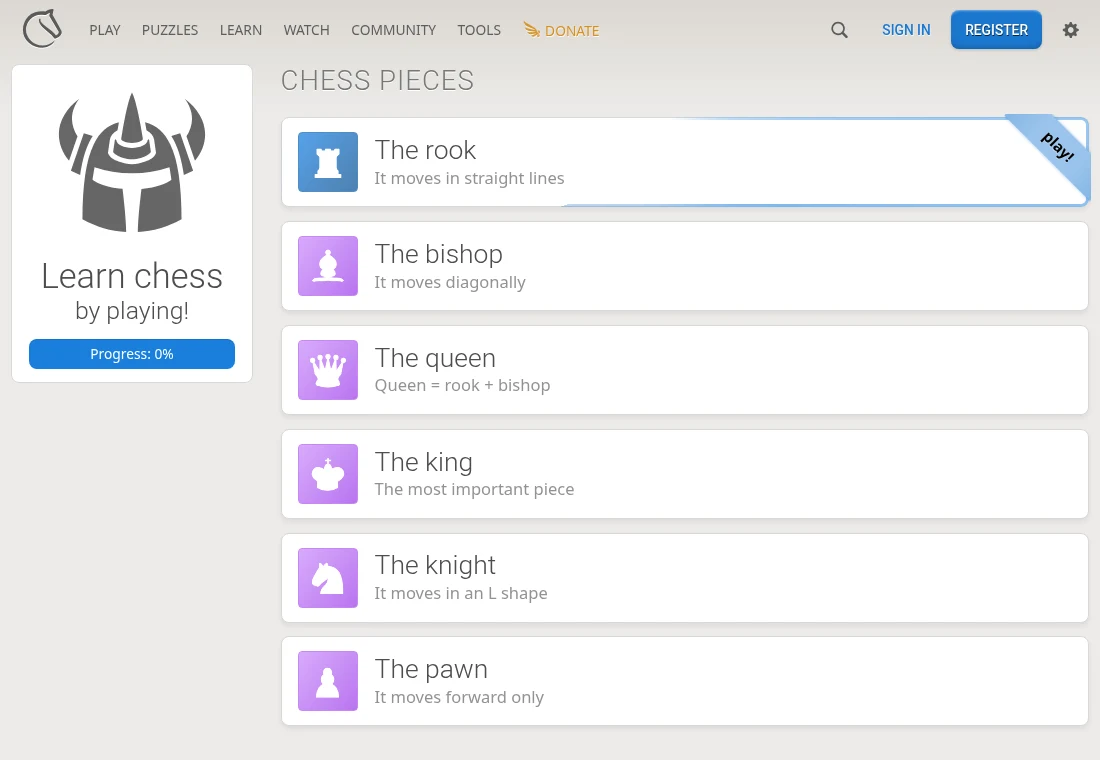
Chess basics presents separate lessons for the pieces. Choose the piece whose movement you are learning and follow its board exercise. Try predicting the legal destinations before selecting a square. A compact exercise removes the need to understand a complete opening while still giving useful feedback about the rule.
Compare the rook and bishop directly
The visible lesson catalogue identifies straight movement for the rook and diagonals for the bishop. Work through those separately, then look at the queen lesson’s combination. Use the actual board exercise to check the idea. Knowing a piece’s name is different from recognizing its possible destinations in a crowded position.
Move to tactics when the rules feel familiar
Puzzles present positions to solve, while the basics area teaches movement and rules. When a puzzle feels confusing, work out whether the difficulty is a tactical choice or an uncertain legal move. Returning to a short rules lesson can resolve the latter without turning every position into an arbitrary guess.
Read a match’s time control
Play is a separate area. Before joining a game, inspect the selected clock and mode so that an unexpectedly short timer does not become the main lesson. Learning through an untimed exercise does not establish readiness for a fast match. Choose a pace in which you can still read the position and the opponent’s reply.
Know where identity matters
The captured public basics catalogue opened without a sign-in. That observation does not establish all account requirements or anonymous progress behavior elsewhere on Lichess. Server history, account identity and local lesson state are different things. Use the original service’s own controls when you want a persistent record; this guide does not maintain a chess account for you.