KEEP THIS HANDY
Controls at a glance.
- Choice buttons
- Choose cooperate or cheat when prompted.
- Advance controls
- Move through the explanation after observing the result.
- Experiment settings
- Change the currently exposed model options, then rerun.
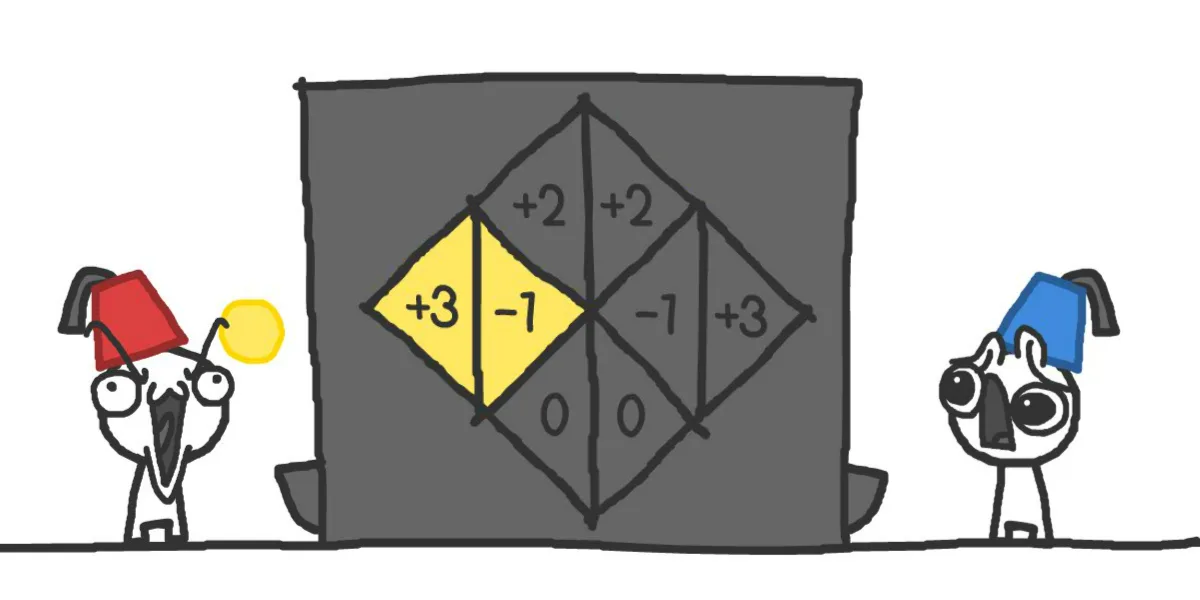
Start with the payoff table
A single cooperate-or-cheat choice has a defined result for both participants. Read those values before judging a strategy by its label. The result of one encounter and the total across repeated encounters answer different questions. Keep both in view when the explanation introduces strategies with a memory of previous moves.
Repeat encounters before drawing a conclusion
The project’s sequence explores what changes when players meet more than once. An action can influence a later response, so a successful one-round choice need not produce the same advantage over a longer run. Compare runs under the same settings before attributing a difference to a strategy alone.
Keep the model’s limits visible
This is an interactive model, with explicit payoffs and rules that simplify social decisions. Use its experiments to understand those assumptions and how outcomes depend on them. It does not measure the trustworthiness of a real person or provide a universal rule for relationships. Third-party sound credits also remain separate from the public-domain original artwork.
What happens to your progress?
Designed as a self-contained interactive explanation. No portable campaign export is established here; allow time to follow its sequence and keep your own notes on experiments.
Check the save and backup guide ↗A FEW USEFUL ANSWERS
Before the next click.
Is it an online multiplayer game?
Its main experience is a sequence of interactive game-theory experiments, not matchmaking with human opponents.
Can I change assumptions?
Later experiments expose model settings. Read the active controls and compare one change at a time.
A useful next read.
The Evolution of Trust: compare the same experiment. ↗Follow the source.
Nicky Case; music by Komiku; third-party audio credits in source. Licence notice. CC0 original work; individual third-party audio licences vary.
Latest collected source change: Updated Arabic translation link (opens a new tab) . Repository activity does not identify the hosted game version.
All media and source credits ↗