KEEP THIS HANDY
Controls at a glance.
- Pointer drag
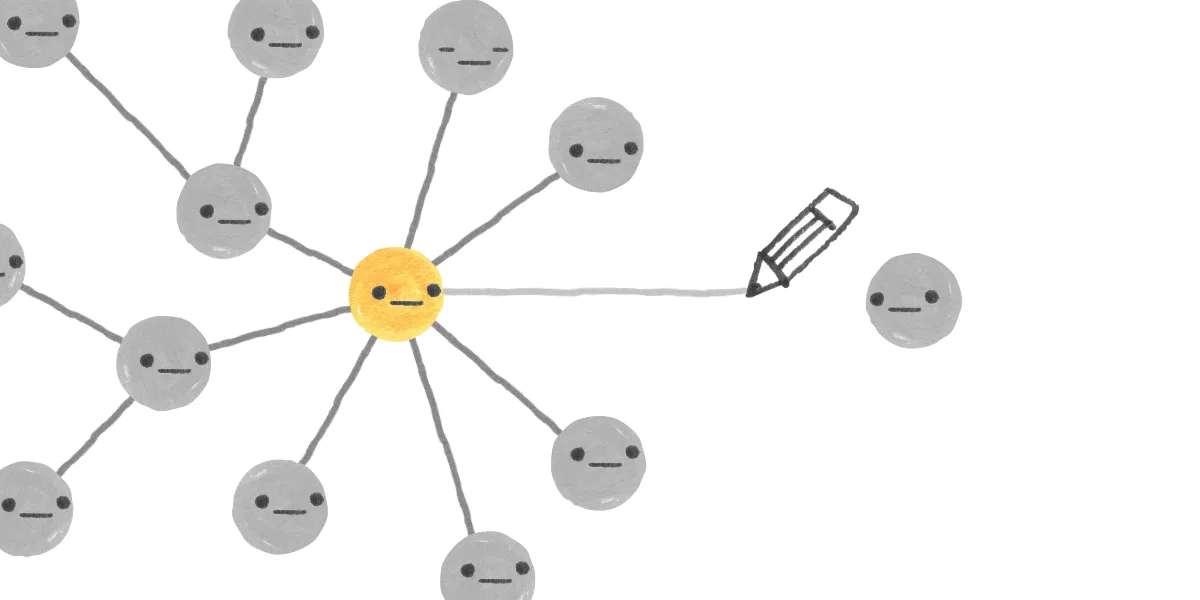
- Draw connections when the current exercise permits it.
- Cut / remove interaction
- Follow the current prompt for removing a connection.
- Advance / simulation controls
- Run the current example and continue after observing it.
Edges are part of the rules
A connection determines which people can influence one another in the current exercise. Read whether the active model concerns a simple spread, a threshold or another behavior before treating every edge as equivalent. The project introduces those ideas through a sequence, so the same gesture can appear in exercises that answer different questions.
Compare one network edit
As an experiment, add or remove a single permitted connection and watch the result. Keeping the rest of the graph fixed gives you a clearer account of what changed. A visually crowded diagram is not automatically better or worse; the behavior also depends on the model being demonstrated and where that connection sits.
Keep models separate from real people
The playable post uses simplified people and explicit rules to explain network effects. Use it to reason about those mechanisms, while retaining the limits of the model. It does not measure an actual community or predict a person’s behavior from a drawn connection. The original repository supplies credits and the implementation behind the exercises.
What happens to your progress?
A portable campaign backup was not established by the reviewed documentation. Treat the linked game and this site’s Saved shortlist as separate records.
Check the save and backup guide ↗A FEW USEFUL ANSWERS
Before the next click.
Is this a multiplayer social network?
It is an interactive explanation with editable network models, not a service for messaging other players.
Do all sections use the same spreading rule?
Read the active explanation. The sequence introduces different network behaviors and assumptions.
A useful next read.
The Evolution of Trust: compare the same experiment. ↗Follow the source.
Nicky Case; music by Komiku; individual sound credits in README. Licence notice. Public-domain original work; third-party sound licences vary.
Latest collected source change: Merge pull request #108 from SMSadegh19/master (opens a new tab) . Repository activity does not identify the hosted game version.
All media and source credits ↗